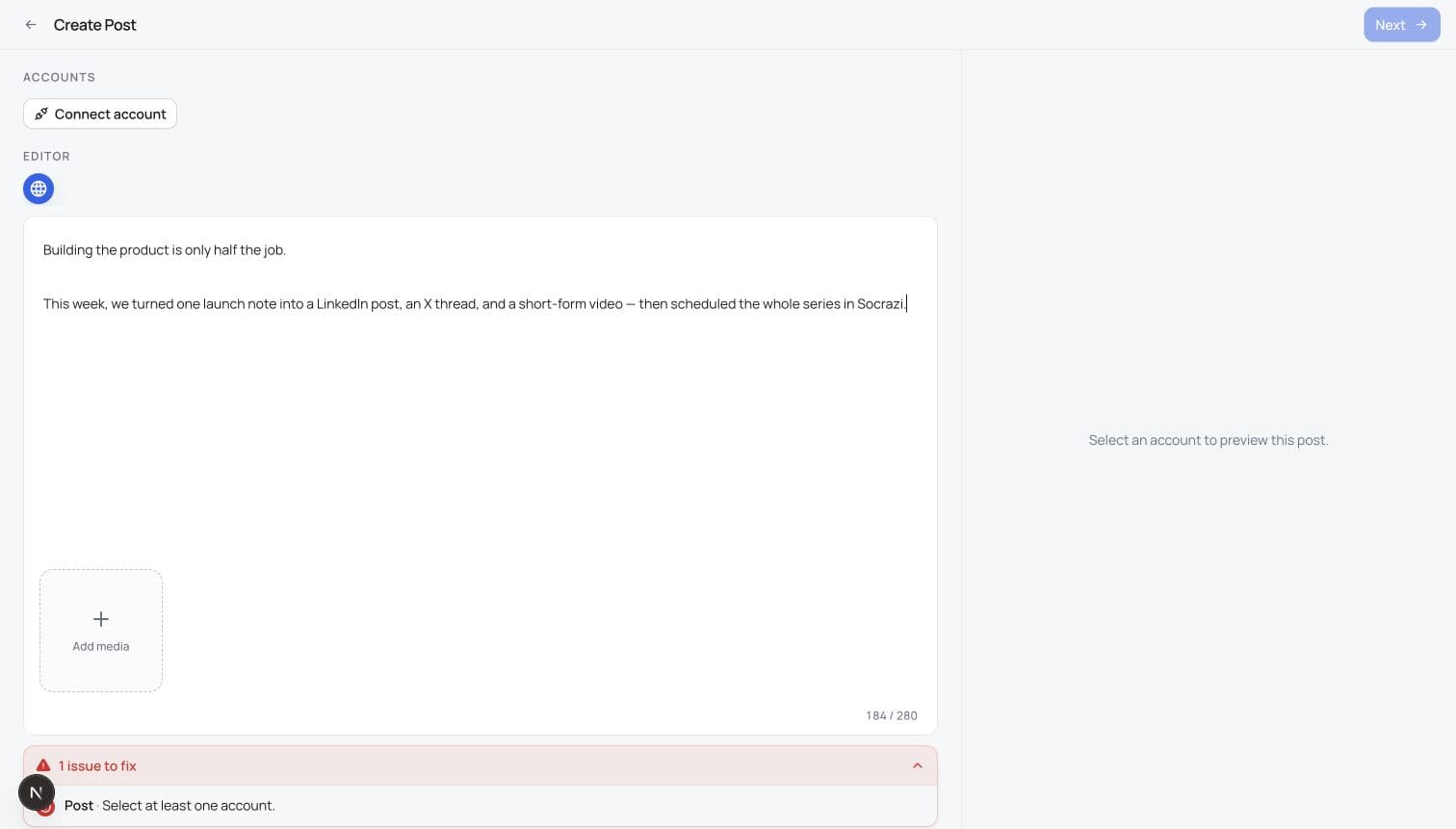
A product update is rarely just an announcement. It contains a customer problem, a decision, a before-and-after, and a lesson. That is enough material for a full week of useful posts.
Find the story beneath the feature
Start with the problem the update removes. “We added calendar filters” is a changelog entry. “You can now find an empty week before it hurts your reach” gives the audience a reason to care.
Write one sentence for the problem, one for the change, and one for the outcome. Those three lines become the source material for every channel.
Match the angle to the network
Each network rewards a different reading behavior. The core truth can stay the same while the delivery changes.
- LinkedIn: explain the customer problem and the product decision
- X and Threads: lead with the sharpest observation or opinion
- Instagram: show the before-and-after as a carousel or Reel
- TikTok: demonstrate the frustrating moment and the faster workflow
- YouTube Shorts: teach the complete workflow in under a minute
Change the hook, not the truth
Platform-native content does not require six unrelated ideas. Use a direct claim for text-first networks, a visible result for visual feeds, and movement in the first seconds of short video.
Avoid inventing a louder promise for every channel. The fastest way to weaken trust is to turn a useful update into six exaggerated announcements.
Repurposing works when the message is stable and the packaging is flexible.
Keep a reusable distribution brief
Save the source story beside the final posts: audience problem, key change, proof, limitation, and call to action. The next time you ship, you can fill the same brief instead of rebuilding the process.
After publishing, compare which angle earned replies, saves, or useful clicks. Carry the winning angle into the next product story.